Test drives were dying. So we turned Toyota TRD Pro into a tour.
Toyota TRD Pro turned a Chicago Auto Show booth into an indoor off-road proof environment, letting drivers feel capability firsthand and remember it through a cultural gaming hook.
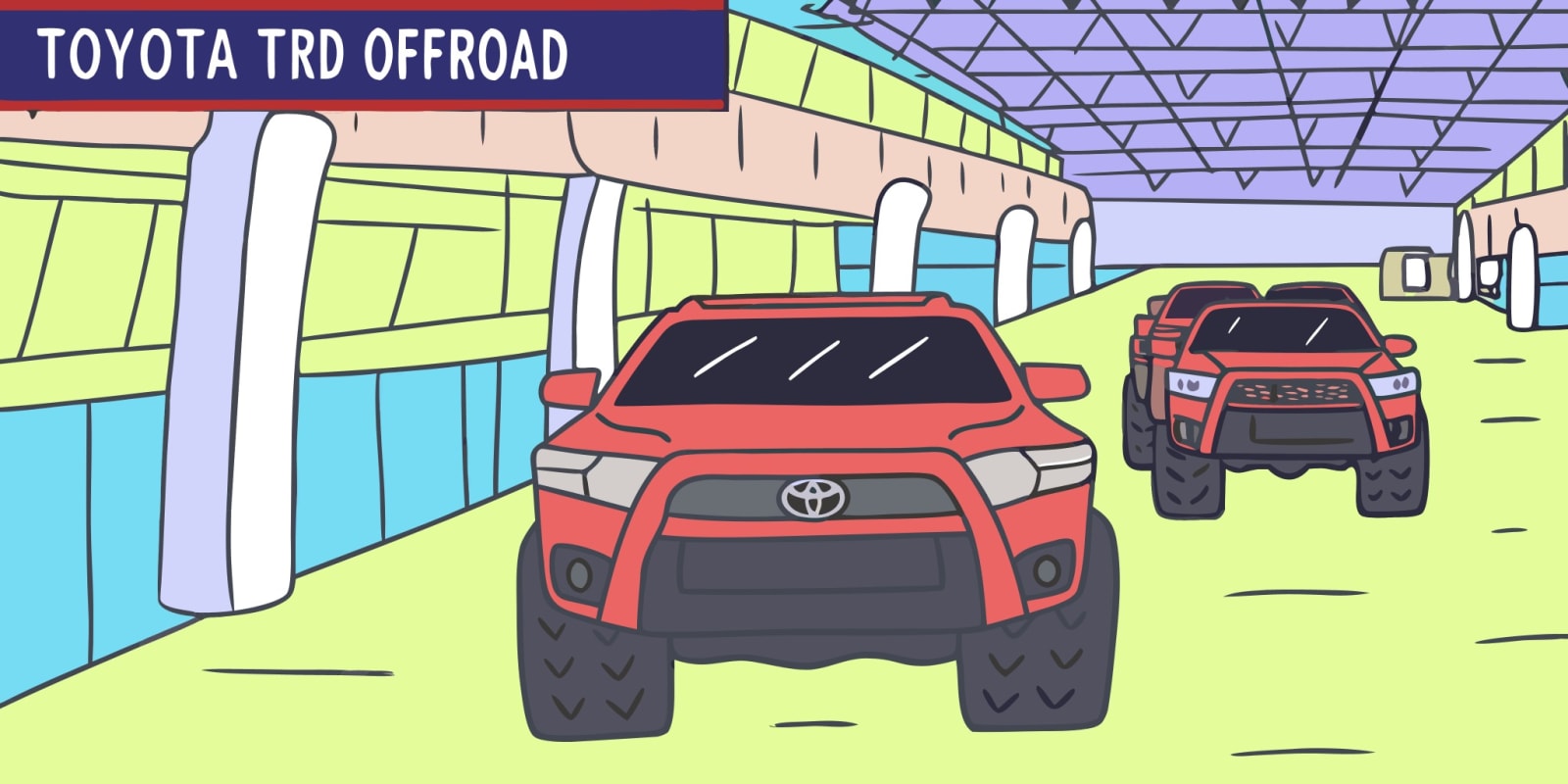
Toyota didn’t need another spec sheet. The TRD Pro lineup already had the capability—across Toyota TRD trucks people actually shop for: Tacoma, 4Runner, and the broader universe of SUVs (and, yes, the occasional “how does this compare to our family minivans?” conversation on the floor).
The issue was where that capability usually gets sold.
A dealer test drive is fine if you’re evaluating cup holders and salesperson vibes. It’s not built to prove what an off-road truck can actually do. Capability has to be felt.
So for the Chicago Auto Show, we built a better way to experience TRD Pro: an indoor off-road track that let people drive the truck the way it was meant to be driven—then we layered in a cultural game mechanic that made the whole thing stick. (Think CES Chicago energy, but grounded in real traction and real torque.)
Not a display. A proof environment.
Want more work like this? Browse the full library: Case studies
The business problem (and the business objectives underneath it)
This wasn’t “make the booth more exciting.” That’s how you get smoke machines and regret.
Toyota’s real problem was strategic:
The product had real value. The market wasn’t feeling it.
The test drive experience had become transactional and forgettable.
The moment that should create belief was delivering… information.
The business objectives and commercial objectives were clear:
Increase new user awareness without relying on overused words or generic feature copy
Improve conversion from “interested” to “I trust this thing” (a different kind of conversion than a form fill)
Create competitive power in a noisy automotive sector by making capability undeniable—especially in a category where buyers cross-shop everything from max crossovers to full-size trucks
Build a clearer strategy that sales and marketing plans could actually rally around (not marketing outputs for a recap deck)
This is what it looks like when a brand isn’t “bad,” just quiet—the early symptoms of a weak brand in a mature category: widely known, rarely felt.
The insight: feature talk doesn’t create belief. felt truth does.
Feature-heavy products have a communication problem.
The more capable the product is, the more tempting it becomes to explain everything:
suspension
traction
clearance
crawl control
engineering
All true. All useful. All dead-on-arrival if the buyer has to imagine what it feels like.
The strategic move (and the important choices it forced) was simple:
Stop explaining capability. Build a place where the truck could prove it.
That’s discipline. That’s brand positioning. And yes—it required rigorous research into:
audiences and what they actually remember at an auto show (including how auto show guests move between attractions and decision hotspots)
customer buying behaviour in high-consideration categories
decision-making cycles that don’t bend just because you printed a bigger badge
What we built: a proof environment engineered around capability
The system we installed
We designed an experience where capability became obvious through use:
An indoor off-road track engineered to showcase TRD Pro capability in real time (a Toyota TRD Pro display you could actually drive)
A test drive format that made the dealer lot feel a million miles away
Physical obstacles designed so specific features had to “show up” to get through—built as an interactive exhibit concept with clear cause-and-effect
A branded environment that wrapped people in the TRD Pro world (not just signage—signal)
A cultural hook: an old-school 8-bit Mickey Thompson Off-Road game tie-in
Custom Toyota TRDs inside the game experience—turning it into branded entertainment, not “content”
A live competition mechanic that gave people a reason to participate, linger, and retell the story
And because auto shows are where attention fragments, we also explored lightweight mixed reality / MR overlays—small, additive moments where computer-generated AR could reinforce what someone just felt in the seat (not replace it). Think quick, skimmable animated AR vignettes that clarified the obstacle they just conquered: the approach angle, the “why” behind traction behavior, the difference between spin and grip. In practice, that meant an exclusion-based AR experience approach—keeping the AR subtle and optional so the hero stayed the same: real driving in real physical vehicles.
This wasn’t a stunt. It was an effective pathway: attention → participation → belief → retellable story.
The shift: from feature claims to proof people can retell
A spec sheet asks the audience to do mental work.
A proof environment does the work for them.
This is why experiential marketing (done right) creates measurable commercial impact: it compresses understanding into a moment.
One physical experience can do what a dozen bullet points can’t:
it changes the thinking from “I get it” to “I felt it”
it turns abstract engineering into lived confidence
it gives people a story they can repeat (which is how awareness actually spreads)
In other words: not marketing outputs. Market effects.
What changed: the test drive became the story
Most auto show activations fight for attention by getting louder.
Toyota had a better move: build something people could enter.
The track turned TRD Pro into a physical experience, not a product display—especially for buyers comparing “best off-road vehicles” in the real world, from Tacoma TRD Pro to 4Runner
The obstacles forced the features to matter (without a salesperson narrating)
The drive created instant contrast against the dealership test drive
The game layer gave it a second life—something to play, share, and remember
The result wasn’t just “fun.” It was brand positioning you could feel.
And because people remember environments, not specs, we treated the course like a sequence of mini-sets: a rocky surface, a wooded setting, even a controlled winter snow setting moment—so the capability felt like it belonged to real trips (including the broader ar camping scene vibe people associate with off-road culture). The truck details became part of the story too: grille, headlights, a visible snorkel air intake, and practical gear talk like a roof rack—the stuff buyers point at when they’re imagining ownership.
Why it worked (the part other automotive brands miss)
Because it respected how people decide.
Even in b2b markets, and especially in high-consideration consumer categories, buyers move through b2b buying cycles and consumer decision-making cycles with the same core filter:
Do I believe this will deliver when it matters?
We didn’t try to win with louder claims. We built a moment that made belief unavoidable.
That kind of belief compounds:
improves win rates over time
supports sales velocity by reducing doubt in the middle of the journey
gives teams a referenceable asset they can build future marketing plans around
Who this framework is for (yes, it translates beyond Toyota)
If you’re in the automotive sector and you sell something “technical,” this applies—whether you’re:
an OEM
a tier 1 supplier
working through dealer networks
running direct sales
selling through a distributor
a startup trying to create trust fast under resource constraints
We’ve seen the same pattern show up across automotive company teams of every shape and size—even niche players (yes, including cmb automotive-style categories): when the product is real, the job is to build the proof.
It also holds when the showroom conversation drifts into totally different vehicles—because that’s what customers do. One minute it’s new Toyota TRD Pro series trucks. Next minute someone’s asking about hybrid sienna, rav4 hybrid plug, or hybrid crown signia because the household decision includes commuters, kids, and weekend miles. Proof still wins—because trust transfers.
The playbook you can steal: “Build proof, not pitches”
Start with defined objectives Tie the experience to goals and business objectives (not “make it pop”).
Design the moment that creates belief Identify the single felt truth that changes perception.
Engineer proof into the environment Build obstacles, demos, and interactions that force the product’s advantage to reveal itself.
Add a retellable layer Culture hooks, competition, community—something that travels beyond the booth.
Systemize it Don’t let the story die after the event. Install the system so it compounds across channels and funnel stage touchpoints.
If you want the “system” side of this—how to keep the signal consistent across teams, channels, and quarters—start here: AI Brand OS
Related links (for context and internal navigation)
More proof-first work: Case studies
Similar “experience as strategy” pattern: Mazda case study
How we think about brand-safe automation (so systems scale without drifting):
AI content governance: Keeping brand-safe automation on track
Ready to map what would actually move the needle? Contact / schedule a call
Takeaway
Toyota TRD Pro didn’t need people to imagine what capability feels like.
They needed a place where the truck could prove it.
By building an indoor off-road track—and wrapping it in a cultural game layer—we turned capability into proof, and proof into participation.
No brochure could do that. The track could.
(And whether the story starts with a 2019 4Runner TRD Pro, a current Toyota TRD Pro series, or the broader lineup of Toyota TRD Pro trucks, the principle stays the same: build proof people can feel, then build a system that makes it travel.)